
Patient guide to insect bites and stings
This page was translated with AI. Only the Danish text has been reviewed by a human — read the Danish version.
About insect stings/bites
Many insects can sting or bite. This is very rarely dangerous, but the skin reaction can be troublesome. The skin develops what is called a local reaction, caused by the immune system responding. This causes itching, redness, warmth, swelling and sometimes tenderness.
The degree of local reaction varies between insects and from person to person.
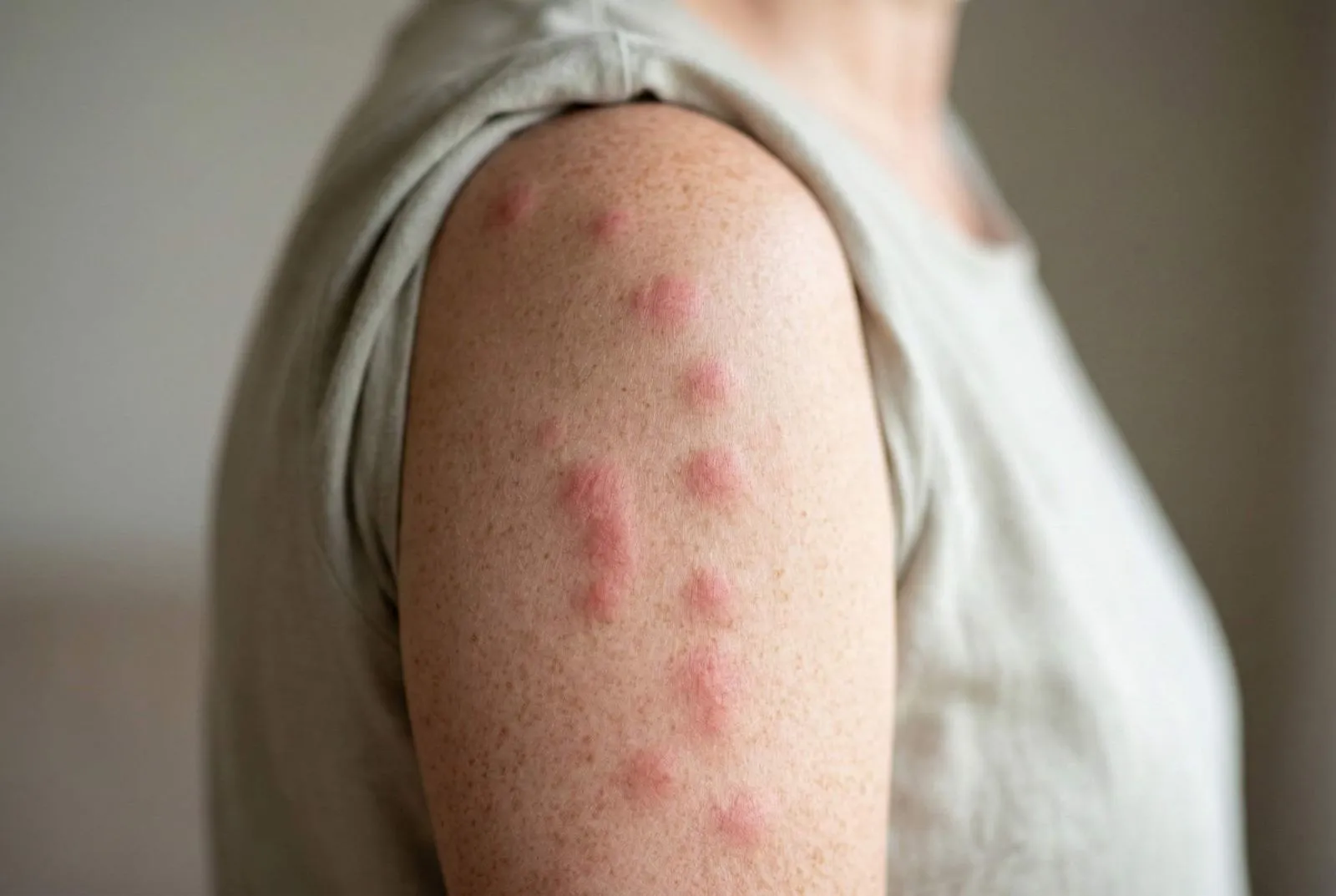
Insect bites and stings can cause red, swollen bumps on the skin, which often itch and may appear in clusters.
Treatment of insect stings/bites
Usually, no treatment is needed. In some cases, symptoms caused by the sting or bite can be treated, for example with an anti-itch product or an antihistamine. If your healthcare professional has found it appropriate, you may have been prescribed additional steroid cream.
Anti-itch treatment (over the counter at the pharmacy)
- Anti-itch cream (Mepyramin)
- Zinc ointment, which has a cooling effect and reduces irritation and itching
Antihistamines
Cetirizine is usually used.
- Take antihistamines until the reaction has settled, usually 2–3 days.
- The dose for adults and children over 12 is 10 mg once daily.
- The dose for children aged 6 to 12 is 5 mg twice daily.
- Children under 6 can have a prescribed oral solution. The dose is stated on the packaging.
- Children under 2 must not have antihistamines.
Steroid cream (hormone cream)
Apply a thin layer of cream to the area with the local reaction morning and evening until the reaction has settled, usually 2–3 days.
- Remember to wash your hands afterwards.
Precautions for insect stings
- For larger reactions, it may be helpful to rest the area.
- If the sting is on an arm or leg, keeping the area raised may help.
- Contact the clinic if you suspect an allergy to insect stings.
Preventing insect stings/bites
- Mosquito repellent spray can be used.
- Wear clothing that covers your arms and legs at dusk.
- Use an insect net if you sleep outdoors.
- Use protection if you work with or approach bees.
Clinically updated 9 March 2026
If you are in doubt, call us
Call the clinic on 73 70 81 10