
Patient guide to nappy rash
This page was translated with AI. Only the Danish text has been reviewed by a human — read the Danish version.
About nappy rash
Nappy rash is a rash in the area covered by the nappy. It is usually caused by heat and moisture, as well as irritation from contact with urine and poo.
The rash can get worse if a fungal infection also develops. This often causes more pronounced redness and can make the rash harder to clear.
Less commonly, a bacterial skin infection can develop, which can also make the rash worse.
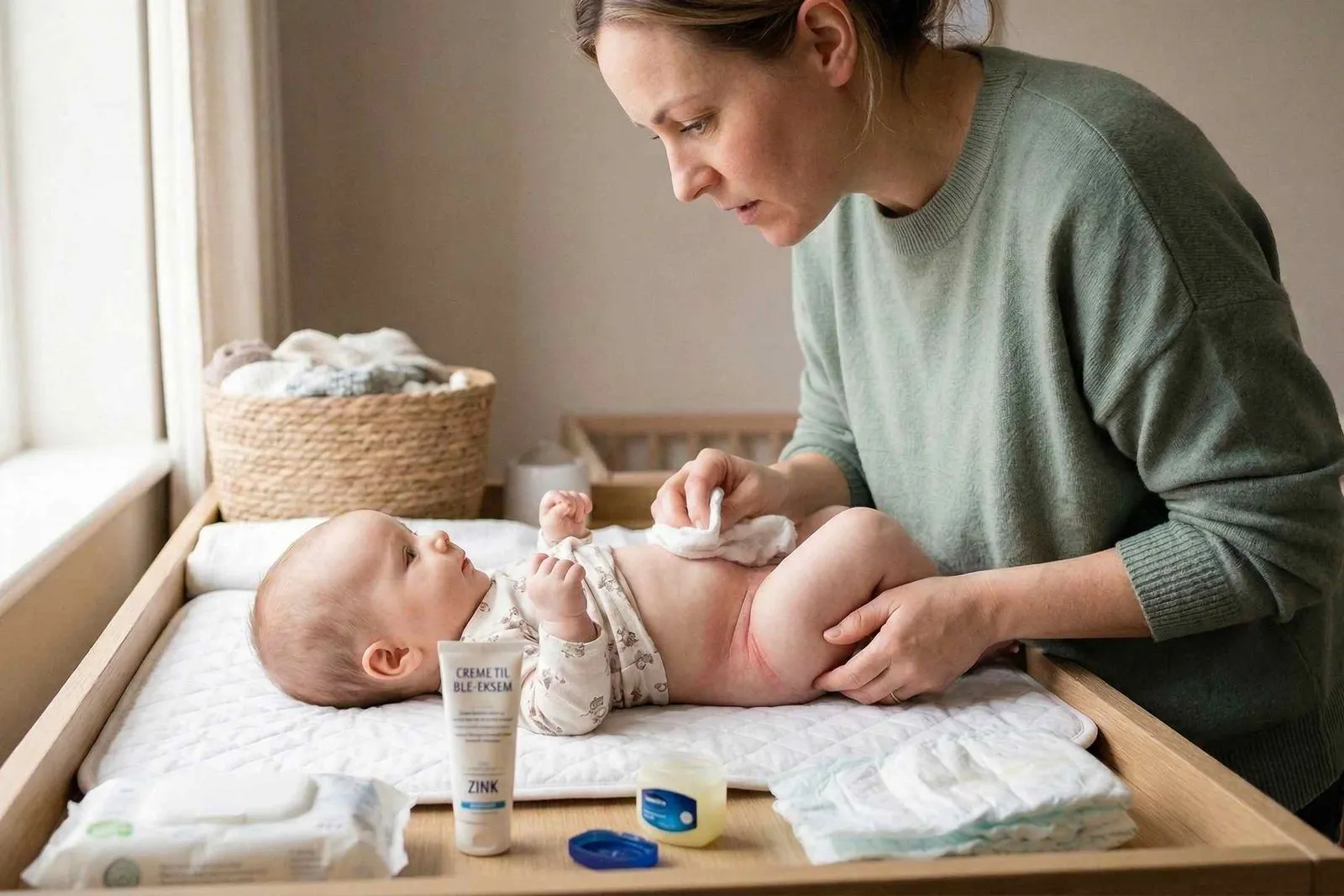
Gentle cleaning and frequent nappy changes can help prevent nappy rash in babies.
Treatment of nappy rash
Mild cases are treated by protecting the skin and reducing irritation in the nappy area.
For more severe symptoms, your healthcare professional may decide that treatment with steroid cream (corticosteroid) is needed. If a fungal infection is also present, an antifungal medicine is used together with steroid cream.
Precautions for nappy rash
The following measures can reduce skin irritation:
- Change nappies frequently to reduce skin contact with urine and poo.
- Wash the skin gently and avoid unnecessary rubbing.
- Pat the skin dry or let it air-dry if possible.
- Use neutral soap or wash without soap.
- Leave the child without a nappy for periods to let air reach the skin.
- Disposable nappies are recommended, as they often absorb better than cloth nappies.
- If the rash keeps coming back, changing to a different nappy brand may help.
Inotyol ointment contains tar and can ease skin irritation. It must only be used on dry areas of rash where no infection is suspected. The ointment is available over the counter.
Protecting the skin
A barrier cream can protect the skin from irritation caused by the nappy and secretions. Several types are available over the counter, including zinc ointment.
Apply the cream after a nappy change, when the skin is clean and dry, before putting on the new nappy.
If steroid cream or an antifungal medicine is also being used, allow these to soak into the skin before applying the barrier cream.
Follow-up
Contact the clinic if there is no improvement within three days, or if the rash gets worse despite treatment.
Preventing nappy rash
Nappy rash is mainly prevented by frequent nappy changes and letting air reach the skin when possible.
- Use neutral soap when washing.
- Disposable nappies are recommended rather than cloth nappies.
Clinically updated 9 March 2026
If you are in doubt, call us
Call the clinic on 73 70 81 10